
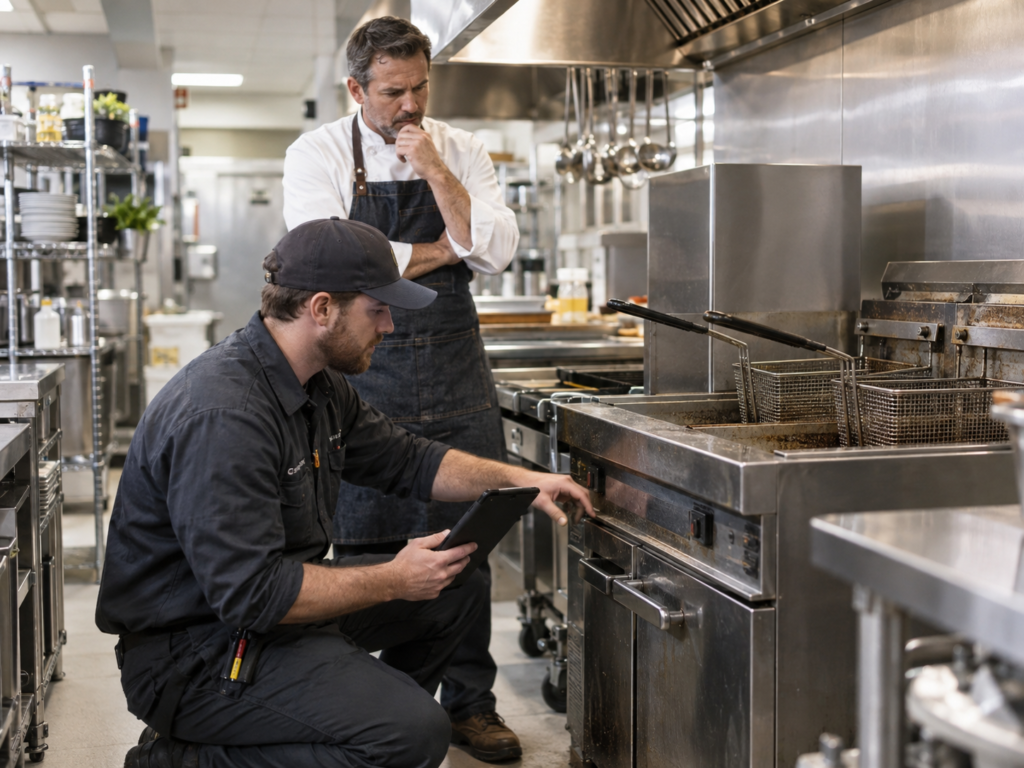
An old oven can continue working for years after a modest repair. A newer fryer can become a replacement candidate after several short outages, even when each individual repair seems affordable.
Age provides context. It does not decide the purchase.
The decision to repair or replace commercial kitchen equipment should be based on what is likely to happen over the next 12 to 24 months. That means looking beyond the current repair invoice to downtime, parts availability, operating performance, utility use and the complete installed cost of a replacement.
A repair can be the right answer for a machine that is old but stable. It can be the wrong answer for equipment that repeatedly interrupts the kitchen’s most profitable service period.
Separate the current fault from the equipment decision
A failed thermostat, heating element or door gasket does not automatically mean the whole machine has reached the end of its useful life. If the fault is isolated, the correct part is available and the repair restores normal performance, keeping the equipment may be financially sensible.
The first question for a qualified service technician is therefore not simply how much the repair costs. It is whether the failed component is the cause of the problem or one symptom of wider deterioration.
Repeated control faults, extensive corrosion, heat damage around wiring or several worn systems appearing together create a different situation from a single replaceable component. The repair quotation may fix the immediate failure without changing the likelihood of another service call.
Safety-related symptoms change the sequence of the decision. Gas odors, exposed electrical parts, repeated breaker trips or unstable operation require the equipment to be taken out of use and assessed according to the kitchen’s safety procedures. That assessment may lead to repair or replacement, but continued operation should not be used as a way to postpone the decision.
Compare the next 24 months
Consider a restaurant evaluating an aging double-vat fryer. The immediate repair quotation is $1,800. A replacement, including delivery, installation and removal of the old unit, would cost $9,500.
The invoice comparison strongly favors repair.
The service records change the picture. Based on recent failures and the technician’s findings, the operator budgets another $2,200 for likely repairs during the next 24 months. The fryer has also caused about 16 hours of interruption per year. Sales and labor records indicate that each unavailable hour costs the operation approximately $180 in lost contribution or recovery work.
Over two years, the estimated downtime cost is $5,760. A model-level energy comparison indicates that the existing fryer would also cost about $900 more per year to operate than the proposed replacement.
The estimated cost of keeping the fryer is now $11,560: the $1,800 immediate repair, $2,200 in anticipated additional work, $5,760 in downtime and $1,800 in additional energy cost. Under these assumptions, the $9,500 replacement becomes the stronger option.
But change the evidence and the answer changes with it. If downtime is worth only $50 per hour and no additional repair is expected, keeping the fryer costs approximately $5,200 over the same period. Repair is then the more defensible decision.
These figures are illustrative. Their purpose is to show which information controls the result. A calculation built on guessed downtime or unsupported energy savings creates false precision.
Fryer capacity may also be part of the problem. If the existing unit is being replaced because it cannot recover during repeated basket loads, the buyer should compare frypot design, usable capacity, filtration and utilities rather than purchasing another machine based only on tank volume. Tarzan’s commercial deep fryer buying guide explains those model-level differences.
Age alone is not a replacement rule
Two machines of the same age may have very different remaining value.
One may operate for a few hours each day, receive scheduled cleaning and have readily available parts. The other may run through two service periods, recover repeatedly from heavy loads and receive attention only after something fails. Their calendar age is identical, but their duty cycles and service histories are not.
An age threshold can trigger a review. It should not replace that review.
The useful records are operating hours, repair frequency, repair type, parts lead time and the effect of each failure on service. A machine with one substantial but repairable fault may remain a better asset than a younger unit with recurring faults that technicians have not resolved.
Parts availability
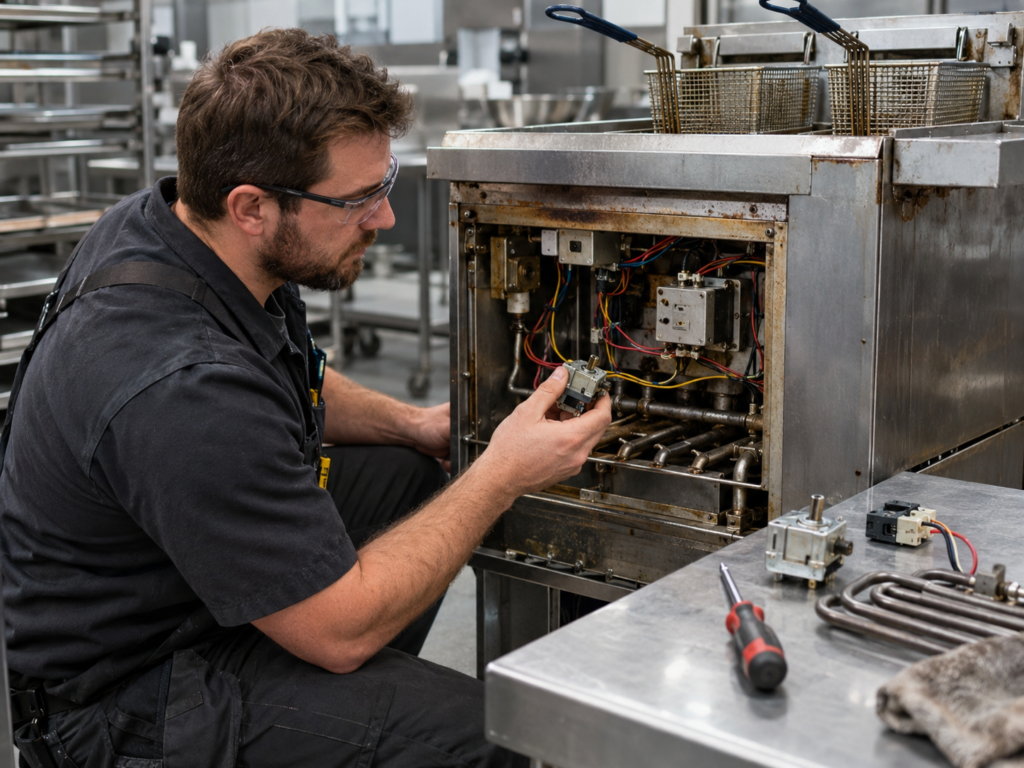
A repair is only inexpensive when the correct part can arrive before the resulting downtime becomes expensive.
A discontinued control board, model-specific gas component or unavailable electronic module can turn a technically repairable machine into an operational liability. In that situation, the buyer is not comparing the price of a spare part with the price of a new machine. The real comparison includes the time required to identify, source, ship and install the part.
For importers and distributors, lead time may matter more than component price. A low-cost part located overseas may still leave a restaurant without critical equipment for several weeks.
Before authorizing another repair, confirm the exact model and serial information, the required part number, whether the component is still produced, the realistic delivery time and whether a compatible alternative has been approved by the manufacturer or service provider.
Replacement sourcing should include the same discipline. Ask which wear parts should be stocked locally, which components are shared across models and which repairs require factory-specific items. A replacement model that is difficult to support may simply begin the same problem again.
Measure the operating gap
Equipment does not have to stop completely before it becomes expensive.
An oven may take longer to recover after the door is opened. A griddle may produce uneven surface temperatures under load. A fryer may complete light orders normally but fall behind when baskets are loaded repeatedly. Staff may compensate by waiting longer, reducing batch size or moving work to another machine.
Those adjustments can hide the problem from management while adding labor and slowing tickets.
Record the actual symptom. Compare warm-up time, recovery, completed batches, rejected food, cleaning time and peak-hour delays with the output the kitchen requires. If performance remains suitable after repair, replacement may add little operational value. If the machine has become a documented bottleneck, the replacement specification should solve that constraint.
This is also where the wider restaurant kitchen equipment planning process becomes useful. Increasing one machine’s output does not help when preparation, refrigeration, holding or staffing is already limiting the line.
Energy savings need model-level evidence
Newer equipment is not automatically cheaper to operate, and a more efficient model does not automatically justify immediate replacement.
The comparison needs expected operating hours, local electricity or gas prices and defensible consumption data for both machines. For eligible equipment and markets, the ENERGY STAR commercial food service equipment resources include certified product information and a calculator for estimating energy and cost differences.
Utility savings should be treated as one part of the decision. They should not be used to hide an oversized machine, an expensive site conversion or assumptions that do not match the kitchen’s workload.
If a replacement saves $900 per year but costs $7,000 more to deliver and install than repairing the existing unit, energy alone does not produce a short payback. If the same replacement also removes repeated downtime and restores peak capacity, the combined case may be much stronger.
Use verified model data where available. For markets without a directly applicable certification or calculator, compare manufacturer data under equivalent test conditions and apply the buyer’s local utility prices.
Check the site before ordering
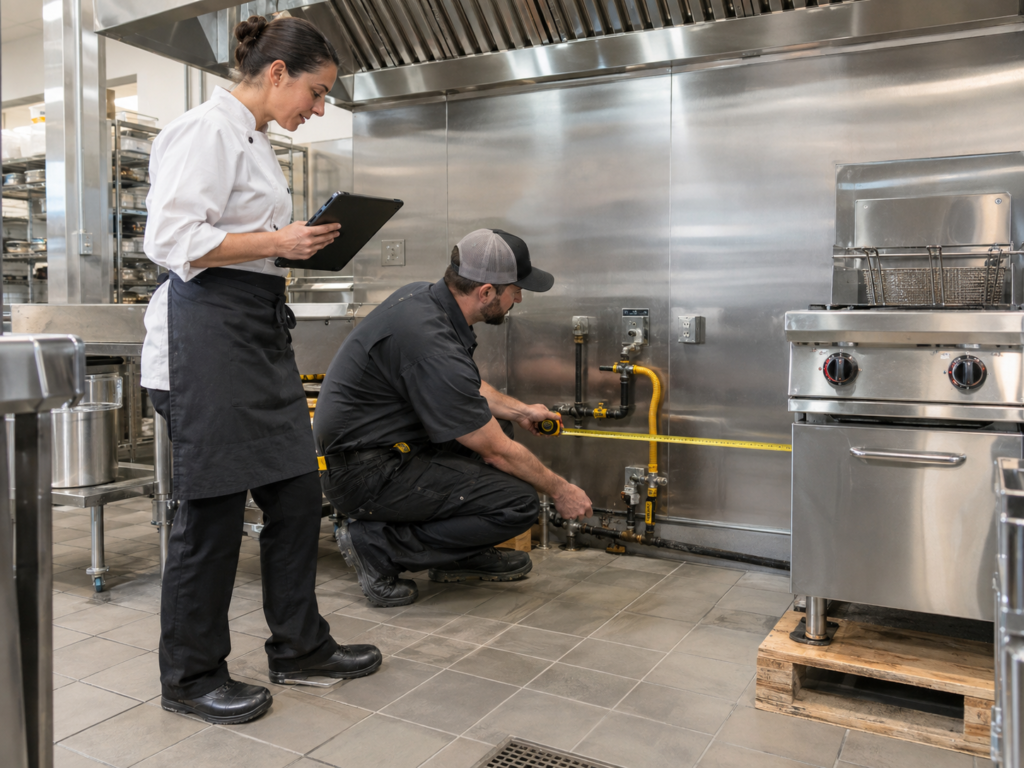
Replacement is not necessarily a like-for-like installation, even when the new machine has similar external dimensions.
Confirm the delivery route, final footprint, service clearances and position beneath the ventilation system. Then check voltage, frequency, phase, connected load, plug or hard-wiring requirements. Gas appliances require confirmation of gas type, operating pressure, connection and any locally required controls. Water, drainage and ventilation must also be checked where they apply.
A higher-output model may require more electrical capacity, gas flow or exhaust volume than the existing connection can provide. Changing from gas to electric can shift operating costs and may require substantial electrical work. A wider or deeper machine can affect aisle clearance and adjacent workstations.
These costs belong in the replacement calculation before quotations are compared.
International buyers must also confirm the destination-market configuration. A familiar model name does not guarantee the correct voltage, frequency, gas setup, plug, labeling or compliance documentation. Tarzan’s commercial cooking equipment range can be reviewed by equipment type, but the final configuration still needs to be confirmed for the installation.
Buyers replacing several machines should review the kitchen as a system. Tarzan’s equipment selection by application provides a starting point for matching equipment categories to the operation rather than replacing each unit in isolation.
Fleet replacement requires a different rule
A restaurant deciding on one machine can focus on that machine’s service record. A chain, distributor or hotel group also needs to consider the installed fleet.
Keeping several versions of the same equipment may require different heating elements, controls, thermostats, gaskets and service procedures. Standardizing future replacements can reduce the number of spare parts and instructions that local teams need to manage. It may also simplify staff training and purchasing.
That does not mean replacing every older unit at once. A phased program can begin with equipment that combines high failure frequency, long parts lead times and high operational importance. Stable machines can remain in service until their evidence changes.
For a multi-location project, test the proposed replacement under a representative workload before applying it across every site. A unit that performs well in a low-volume branch may not suit the chain’s busiest kitchen, even when the menu is similar.
Prepare the replacement specification before requesting prices
A useful quotation starts with the existing problem.
Provide the old model, available nameplate information, service history, current fault and reason replacement is being considered. Add the menu function, normal and peak workload, available space, site utilities, ventilation conditions and destination market.
The replacement quotation should identify the proposed model, configuration, included accessories, freight basis, installation responsibility, available technical documents and recommended spare parts. Importers should also state the quantity, branding or packaging requirements and whether the order is a trial purchase or part of a wider replacement program.
When these details are ready, they can be submitted through Tarzan’s commercial kitchen equipment RFQ for a model and configuration review.
Repair when an identifiable fix can restore the required performance with acceptable downtime and available parts. Replace when the forward cost and operating risk of keeping the equipment approach or exceed the complete cost of putting the right new unit into service.