
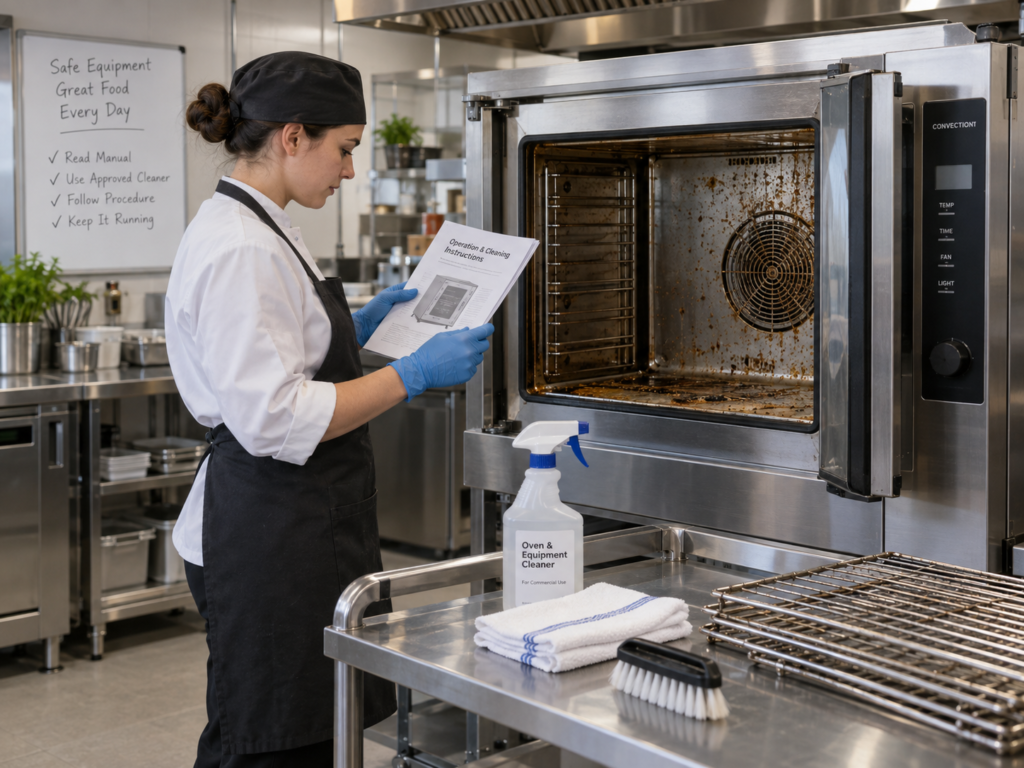
The safest way to clean a commercial oven is not to begin with a bottle of degreaser. Start with the oven’s operating manual.
An oven can look clean around the door while grease remains near the fan guard, rack supports or seals. The opposite mistake can be costly: applying a strong chemical and abrasive pad to every dark mark may damage a liner, coated surface or gasket.
There is no universal cleaning routine for every commercial oven. The oven design, chamber material, menu, soil load and cleaning system determine what can be removed, which chemical is suitable and whether the appliance should remain powered during cleaning.
Identify the oven before choosing the method
Commercial ovens include several types of equipment.
A convection oven circulates hot air with a fan. A deck oven transfers much of its heat through the baking surface and chamber. A combi oven adds steam, water connections, drainage and programmed cleaning functions. Conveyor, rotisserie and high-speed ovens introduce other removable components and protected areas.
Before cleaning begins, confirm the model number and obtain its current operating and cleaning instructions. The manual should identify the chamber material, removable components, approved cleaning products, shutdown procedure and areas that must not be sprayed.
This distinction matters when an oven has an automatic cleaning program. A programmed cycle may need power, water, drainage and a specified chemical. Disconnecting every oven before cleaning can be wrong because some automatic systems must remain operational. A manually cleaned oven may require a different shutdown and energy-isolation procedure.
If the instructions are missing, ask the equipment supplier or manufacturer for them. Do not borrow a procedure from another oven simply because the machines look similar.
The same checklist fails in two different kitchens
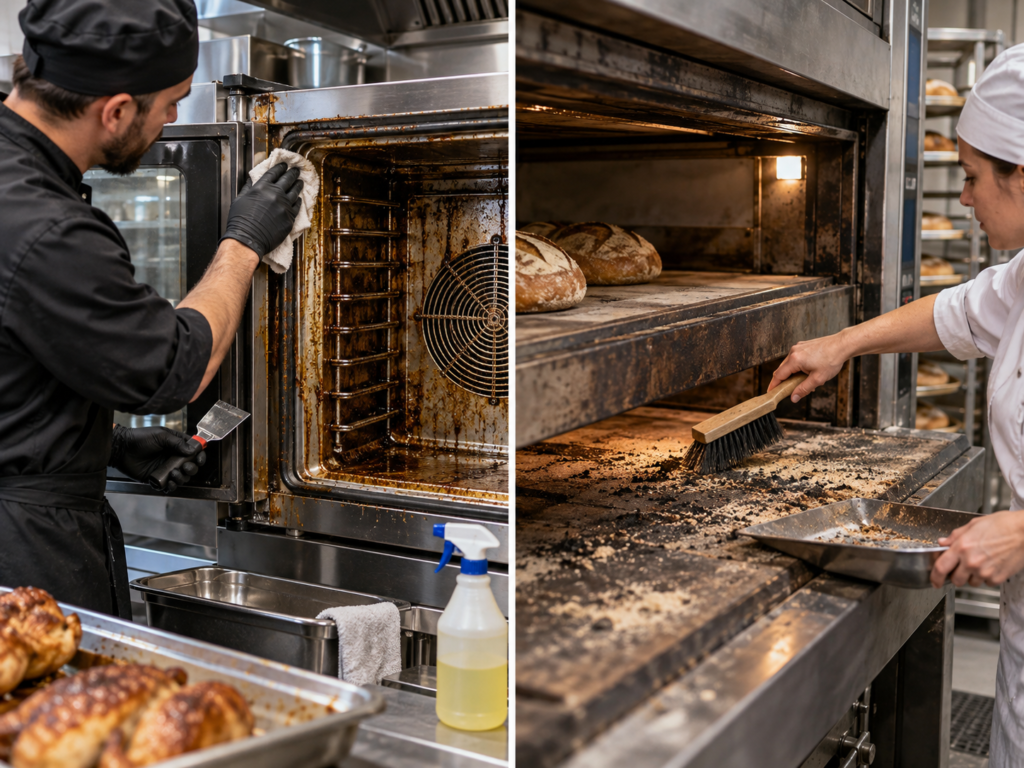
A roast-heavy restaurant and a bread bakery show why the cleaning method must reflect how the oven is used.
Repeated trays of marinated poultry can produce grease vapor and splashes. Residue may collect on rack guides, door glass, seals and accessible airflow components. Removing crumbs from the oven floor will not deal with these deposits. If buildup interferes with the door seal or airflow path, the oven may behave differently even when the visible chamber has been wiped.
A bread bakery faces another problem. Flour, crumbs and carbonized residue may collect around the deck surface. Some baking stones and deck materials should not be saturated with water or treated with an aggressive oven cleaner. Loose dry residue may need to be brushed or scraped away with an approved tool before damp cleaning is considered.
Both kitchens can clean their ovens every night and still require very different procedures.
The restaurant may need frequent grease control and scheduled cleaning of user-accessible airflow components. The bakery may depend more on dry debris removal and protection of the deck material. Neither method should be transferred to the other kitchen without checking the relevant manual.
A safe manual-cleaning sequence
Manual cleaning starts after production has ended and the oven has reached the condition specified by its manufacturer. Staff should not judge the required cooling condition by touching the door. Cleaning products and oven designs have different temperature limits, while an automatic cycle may require a defined starting temperature.
Follow the model’s shutdown or isolation instructions. Remove food, trays and pans, then take out only the racks, guides, trays or guards identified as user-removable. Components that require a service panel to be opened usually belong in a maintenance procedure, not the nightly cleaning routine.
Remove loose crumbs and dry debris before applying liquid cleaner. Otherwise, the detergent can turn removable debris into a paste that spreads into corners and openings. Use a dedicated brush, scraper or vacuum only when the manual permits that method and the tool will not damage the surface.
Apply the approved cleaner at the stated dilution and contact time. Do not spray chemicals indiscriminately around control panels, heating elements, burner ports, igniters, fan motors, temperature probes or electrical openings. If the instructions say to apply cleaner to a cloth instead of spraying it directly into the chamber, follow that method.
After the soil has loosened, remove the residue using the rinsing or wiping procedure stated on the product label and in the oven manual. Cleaner left inside the chamber can cause odors or smoke and may come into contact with food-contact components during the next service.
Allow cleaned parts to dry as required before reassembly. Check that the door closes correctly, the gasket is seated, removable components are secure and no cloth, brush or tool remains inside.
Cleaning staff should record abnormalities rather than attempting repairs. A damaged gasket, loose hinge, cracked glass, recurring error code, water leak, ignition problem or persistent smoke needs assessment by an appropriately qualified technician.
Clean the areas that change oven behavior
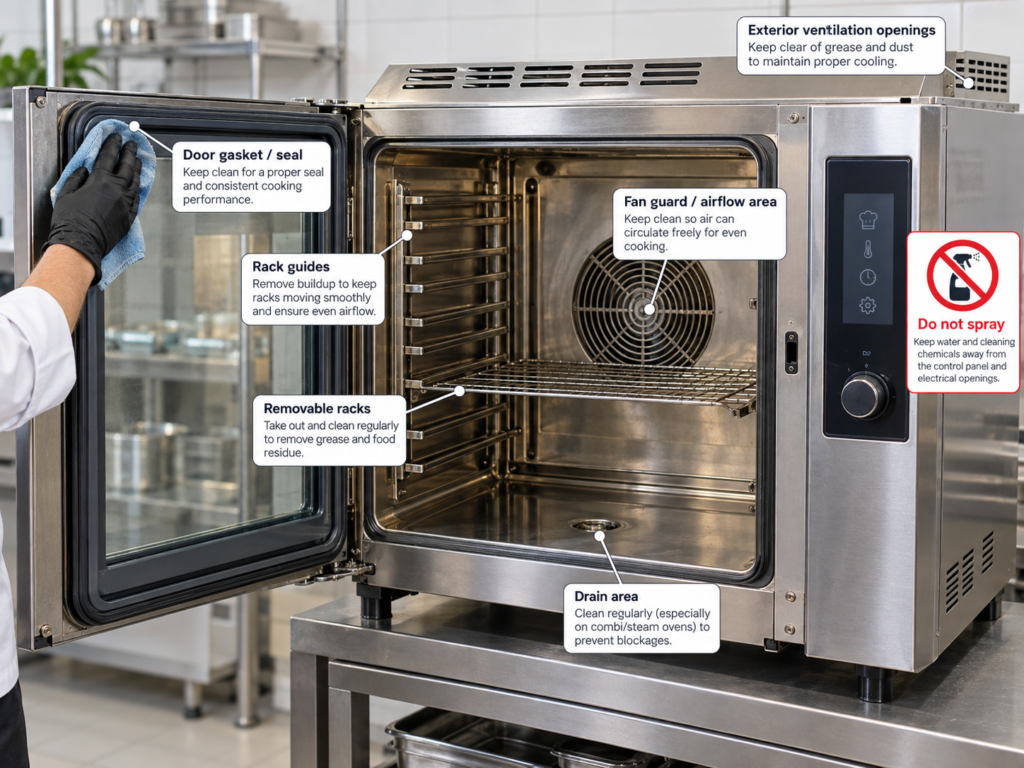
The most visible soil is not always the most important.
A dirty door seal can prevent the door from closing as intended. Residue around an accessible fan guard may obstruct the airflow path in a convection oven. Food debris in an approved drain area can disrupt a combi oven’s cleaning or moisture-management process. Blocked exterior ventilation openings may restrict cooling around internal components.
These areas still require model-specific handling. A removable fan cover is not permission to wash the motor behind it. An accessible drain is not permission to pour in an unapproved chemical. Cleaning access ends where technical service begins.
Cleaning should also be considered during the wider restaurant kitchen equipment planning process. An oven that fits the cooking line but leaves no room to open a service panel, remove a rack frame or reach the surrounding floor creates a maintenance problem before it enters service.
Daily cleaning and deep cleaning are different jobs
A fixed daily-and-monthly schedule sounds simple, but it may be too blunt for commercial use.
Daily or post-shift work should control fresh spills, loose debris and soil on the surfaces identified in the operating procedure. A kitchen roasting fatty products for long hours may need more frequent attention than a bakery running several short batches of dry bread products.
Deep-cleaning frequency should respond to the menu, operating hours, soil accumulation and manufacturer’s schedule. Waiting for the first day of every month makes little sense if heavy buildup appears after ten days. A weekly deep clean is equally difficult to justify if it requires unnecessary disassembly that the manufacturer does not recommend.
In the United States, the FDA Food Code says food-contact surfaces of cooking and baking equipment should be cleaned at least every 24 hours. Non-food-contact surfaces should be cleaned often enough to prevent soil accumulation. The Food Code is a model offered for adoption by individual jurisdictions rather than a universal federal operating rule, so kitchens must confirm the requirements that apply locally.
A useful cleaning record identifies the oven, task, method, chemical, employee and completion time. It should also record problems such as a deteriorating gasket or slow drain. This turns cleaning into preventive maintenance instead of an undocumented end-of-shift chore.
The cleaning chemical is part of the procedure
A commercial-grade cleaner is not automatically compatible with every commercial oven.
The selected product must suit the chamber material, coating and type of residue. Its label and the oven manual determine the dilution, application method, contact time, rinsing procedure and required protective equipment. A product marketed as natural or environmentally preferable still needs a compatibility check.
Never mix cleaning chemicals. Staff should have access to product labels and Safety Data Sheets and understand the protective equipment required for the chemicals they handle. OSHA’s guidance for workers using cleaning chemicals addresses training, labels, Safety Data Sheets and protective equipment.
Chemical availability also matters to importers and multi-location operators. An oven that depends on a proprietary cleaner may be easy to support at the first location and difficult to maintain in another market. Before standardizing the model, buyers should confirm the cleaner specification, local availability, storage requirements and expected consumption.
Maintainability should influence the purchase
Cleaning cost begins with equipment design.
Buyers comparing commercial bakery equipment usually focus on tray capacity, temperature range, utilities and purchase price. Cleaning access deserves similar attention because it affects labor, downtime and whether staff can follow the required procedure consistently.
Ask the supplier to show how rack guides, crumb trays and other user-removable components come out. Confirm whether the door glass, gasket, fan guard and drain areas are accessible under the normal cleaning procedure. Request the cleaning manual before ordering rather than waiting until the oven arrives.
For an automatic cleaning system, establish the available cycle options, approximate downtime, water and drainage requirements, approved chemicals and recurring consumables. Automatic cleaning reduces some manual work, but staff may still need to inspect seals, removable parts and areas outside the programmed wash path.
The quotation should also identify replaceable wear parts and explain how they are ordered. Door gaskets, cleaning tablets, filters and other consumables may be inexpensive individually, yet still become an operational problem when the correct part is unavailable in the destination market.
For project buyers, Tarzan’s equipment planning by application can help place the oven within the wider cooking, preparation and cleaning workflow. The useful question is not whether an oven is advertised as easy to clean. Buyers need to see the actual procedure, required access and ongoing inputs before purchase.
What to provide when requesting an oven quotation
An oven RFQ should state what will be cooked, expected daily and peak workload, oven type, required capacity, destination market and available utilities. For combi or steam-assisted equipment, include the water, drainage and water-treatment conditions where known.
Ask the supplier to provide the operating and cleaning manual, approved chemical specification, cleaning-cycle information, consumable requirements and recommended spare parts for the quoted model. These documents should correspond to the exact configuration being supplied.
When requesting a commercial oven quotation, include these maintenance requirements with the voltage, frequency, phase, dimensions and production needs. A quotation is incomplete if it prices the oven but leaves daily cleaning, consumables and service access unanswered.