
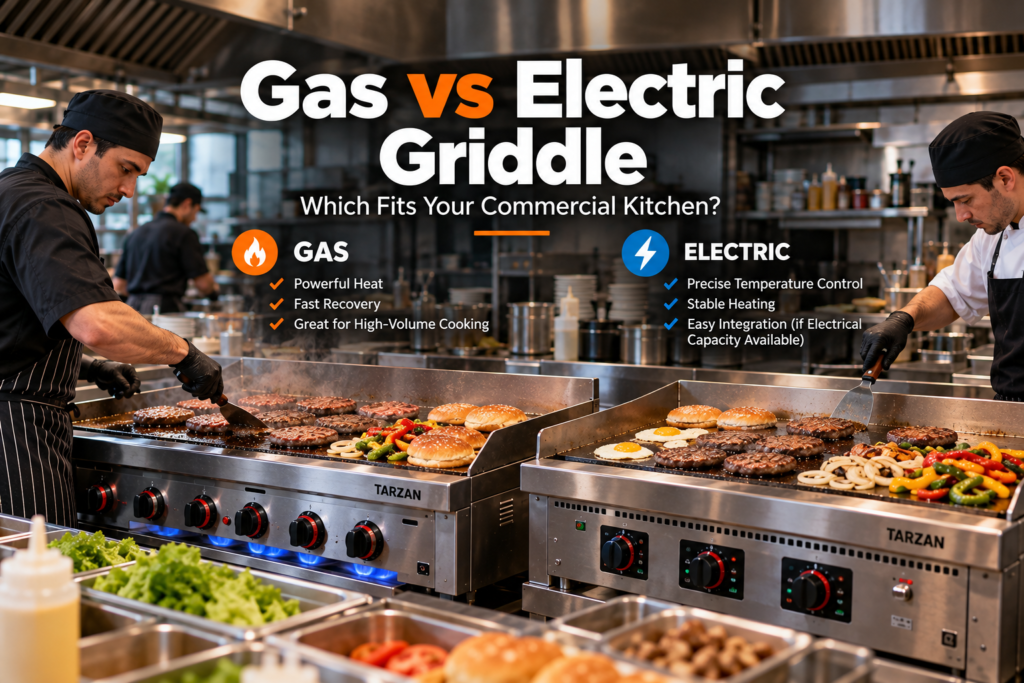
Choosing between a gas and electric griddle is not simply a question of which fuel cooks better.
A restaurant replacing a gas griddle may find an electric model with the right cooking area and an attractive purchase price, only to discover that the existing electrical service cannot support it without new wiring, breakers or panel work. The reverse can happen in a kitchen with adequate electrical capacity but no suitable gas connection.
That is why a gas vs electric griddle comparison should start with the site, then move to cooking performance.
If the kitchen already has a suitable gas supply, a commercial gas griddle deserves consideration. If the required electrical capacity is already available, an electric griddle may be easier to integrate. When both are practical, the decision should come down to peak-service performance, installed cost, operating cost and serviceability rather than fuel type alone.
Start with the utilities already available
Before shortlisting commercial gas griddles, confirm the available gas type, supply capacity, required inlet pressure and connection arrangement with the equipment supplier and qualified installer.
Natural gas and LPG configurations should not be treated as interchangeable. If a model can be converted, the work should follow the manufacturer’s approved parts and procedures.
For commercial electric griddles, check the required voltage, frequency, phase, connected load and connection method.
A socket near the cooking line does not necessarily mean the building has enough electrical capacity for the proposed griddle. The installer needs to consider the griddle together with the other equipment operating during peak service.
Electric should not automatically be treated as a hood-free option either. Cooking still generates heat, grease and fumes. The UK Health and Safety Executive’s guidance on catering kitchen ventilation discusses cooking emissions and the additional combustion-air considerations associated with gas-fired equipment.
Ventilation, fire protection and installation requirements vary by market, so international projects should always be checked against the applicable local rules.
Before comparing equipment prices, obtain the likely site-work cost as well. Electrical upgrades, gas work, supporting stands or counters, ventilation changes, installation and commissioning can easily change which griddle represents the better overall purchase.
Compare performance during the busiest service period
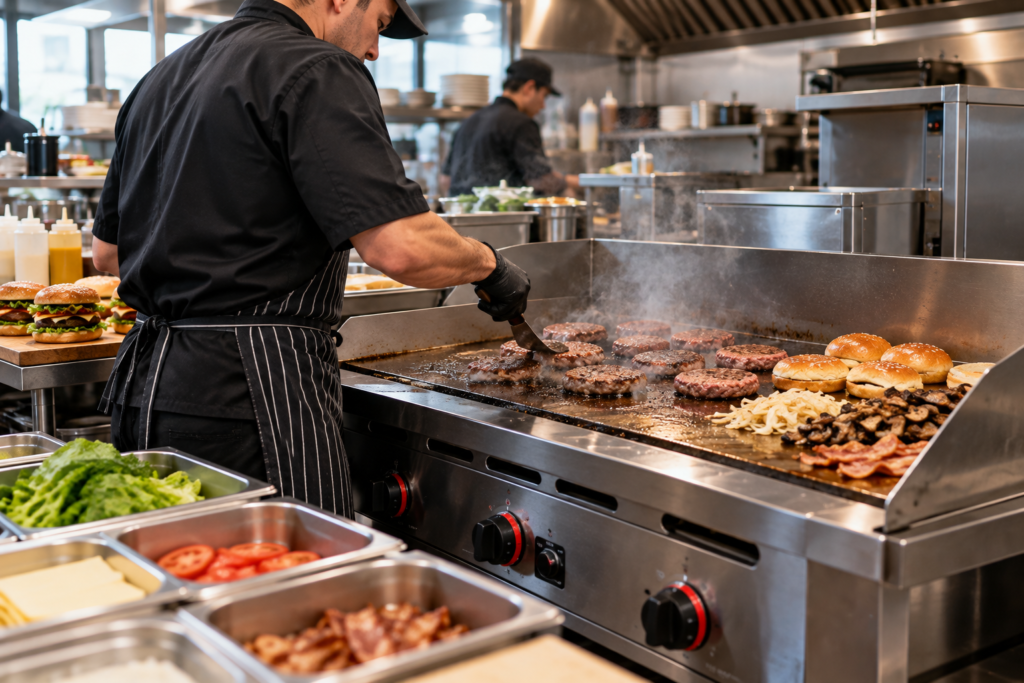
Cooking area matters, but plate width alone does not tell you how many acceptable portions a griddle can produce during a rush.
Output also depends on portion size, food temperature, loading pattern, plate recovery, control system and operator workflow.
Consider a restaurant that needs 40 burger patties during a 15-minute peak window. Suppose two griddles can each hold 16 patties using the restaurant’s normal spacing.
If one completes a full load-and-recovery cycle in six minutes, it can finish two complete batches within that period, or 32 patties. If the other completes the same process in five minutes, it can finish three batches, or 48 patties.
These numbers are only an illustration. They are not performance ratings for gas or electric griddles.
Reverse the measured cycle times and the purchasing decision reverses as well.
The important point is that fuel type, rated input and cooking width do not by themselves establish service capacity.
Where possible, test shortlisted models under repeated loads using the intended portion size, food starting temperature, spacing and required finished quality. Pay particular attention to later batches. A griddle that performs well on the first load may slow down if the plate cannot recover sufficiently between batches.
Also look beyond the griddle itself. Increasing plate capacity will not improve service speed if assembly, staffing or another piece of equipment has already become the bottleneck.
Tarzan’s guide to planning commercial kitchen equipment looks at that decision across the wider production line.
Plate thickness matters, but it does not tell the whole story
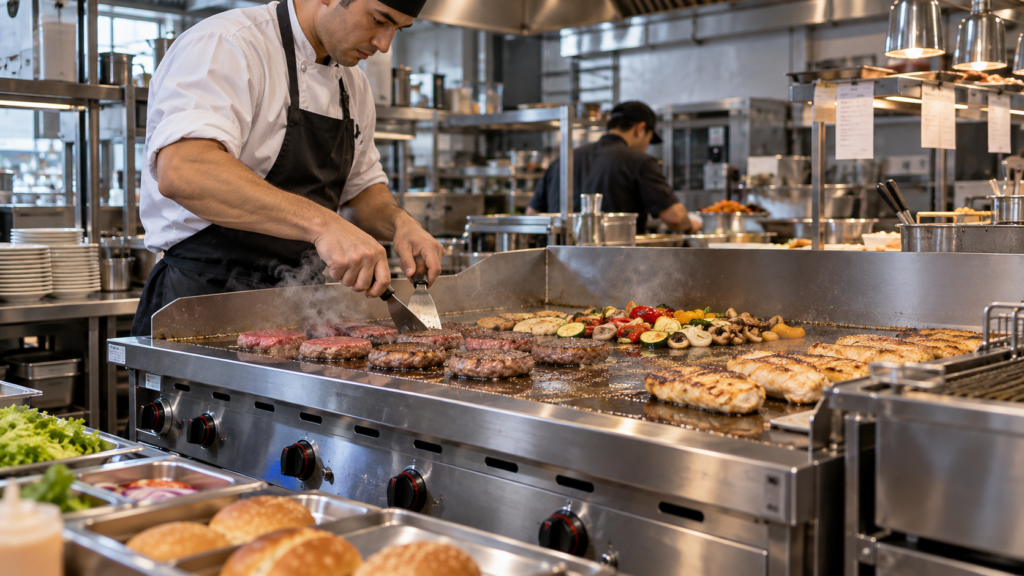
The cooking plate is one reason two similarly sized griddles can behave differently under load.
For plates made from the same material and with the same cooking area, a thicker plate has greater mass and can store more thermal energy at a given temperature. That thermal reserve can help reduce the immediate temperature drop when cold food is placed on the surface.
However, plate thickness alone does not determine recovery speed.
Recovery also depends on heater or burner capacity, heat transfer, control strategy and the design of the complete cooking system.
Buyers should also confirm the actual cooking-surface material rather than assuming that a stainless steel cabinet means the food is cooked directly on stainless steel. The body construction and cooking plate may use different materials.
Compare the control system separately from the fuel type
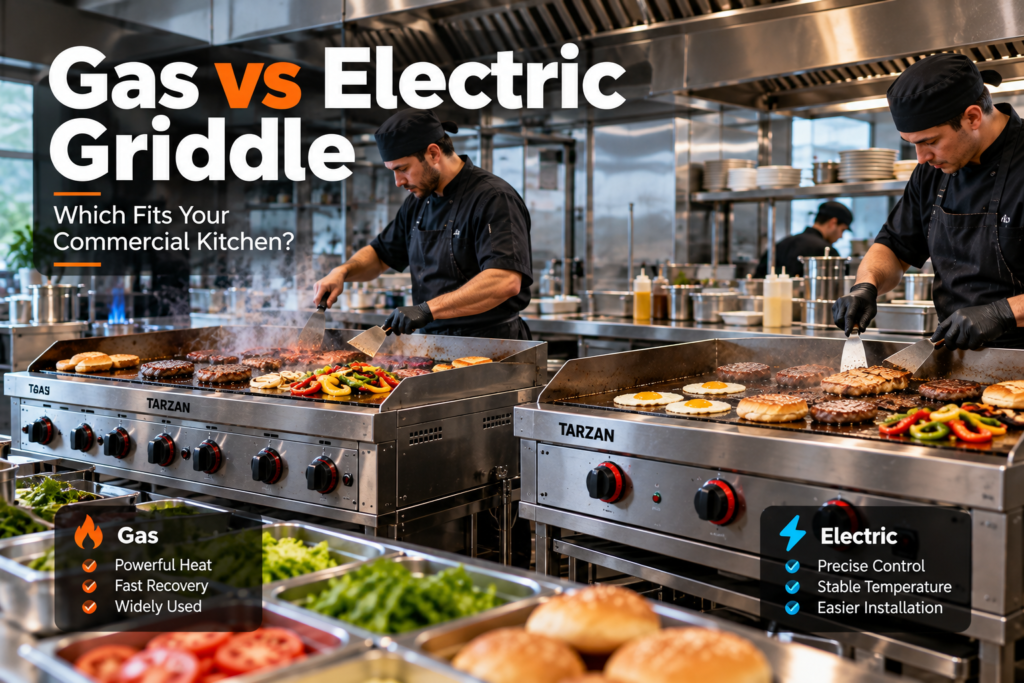
Fuel type and control type are separate purchasing decisions.
Gas griddles may use manual or thermostatic controls, while electric griddles can also use different control arrangements depending on the model.
With thermostatic control, plate-temperature feedback is used to regulate heating. ENERGY STAR notes that this type of control can respond to changes in cooking load and support recovery when fresh product is placed on the cooking surface.
That does not automatically make every thermostatic griddle superior for every kitchen, but it does mean buyers should compare the control system rather than assuming performance from the fuel source alone.
For menus that require different cooking temperatures at the same time, also check how many independently controlled zones are available and how they are arranged.
Because heat still moves through a continuous griddle plate, neighboring zones should not be treated as completely separate cooking surfaces. For demanding applications, surface-temperature measurements under actual load are more useful than dial settings alone.
Calculate energy cost from real operating conditions
The rated gas or electrical input is important for installation, but it is not an annual energy-consumption figure.
Simply multiplying maximum input by every hour the restaurant is open assumes that the griddle operates continuously at full power. In most kitchens, that will not reflect actual use.
Instead, look at how the griddle will operate throughout the day: preheating, active cooking, slower periods and time spent holding temperature between orders.
The U.S. Department of Energy’s commercial griddle purchasing guidance includes idle consumption when evaluating operating cost and states the workload, operating hours and energy-price assumptions behind its examples.
Those assumptions are useful as a reference, but they should be replaced with the buyer’s own operating schedule and local gas or electricity tariff when comparing two models.
For a restaurant with long periods between peak services, idle consumption may have a meaningful effect on annual cost even when both machines can handle the required cooking load.
Any claimed annual saving should therefore show the operating assumptions behind it.
Check cleaning and grease handling before ordering
Gas versus electric tells you very little about the cleaning work staff will face every day.
Inspect the route from the cooking plate to the grease trough and collection drawer. Check whether the drawer can be removed easily once the griddle is installed beside other equipment and whether staff can reach the areas that require routine cleaning.
The cooking-surface finish also matters.
Cleaning methods suitable for one type of plate may damage another, so obtain the manufacturer’s cleaning instructions for the exact model before specifying scrapers, abrasives or chemicals.
For distributors and importers, cleaning instructions and access to replacement components should be considered during product selection rather than after equipment is already in the market.
Importers should specify the utility configuration clearly
For international buyers, one griddle model may be offered in several market-specific configurations.
Electrical orders should clearly identify voltage, frequency, phase and connected load. Gas orders should identify the intended gas type and required supply conditions.
Do not assume that a familiar model name guarantees the correct configuration for every destination.
Importers should also confirm which manuals, technical documents, spare parts and destination-market documentation apply to the exact version being quoted.
This becomes particularly important when the same distributor supplies equipment into several countries or regions.
Gas or electric: which should you choose?
If the kitchen already has a suitable gas installation, a gas griddle is a logical candidate.
If sufficient electrical capacity is already available and adding gas would require substantial work, an electric griddle may make more sense.
When both utilities are practical, neither fuel should win automatically.
Compare two griddles that can handle the same peak workload, then evaluate their complete installed cost, operating cost, controls, cleaning access and available service support.
If only one model can reliably meet the required production rate, solve that capacity issue before comparing purchase price.
For distributors, restaurant groups and commercial kitchen projects, the safest approach is to specify the job first and the equipment second.
Send Tarzan your menu or expected workload, available gas or electrical supply, destination market and required quantity through the commercial griddle RFQ. We can then match the quotation to the required utility configuration and commercial application.