
Ghost kitchen operators often try to save space by buying the fewest machines possible. The result can be a compact room full of “versatile” equipment that still struggles during the dinner rush.
The fryer is shared until chicken and fries are ordered together. The only preparation table becomes a packing station. Refrigerated ingredients are stored across the room because no space was reserved beside the line. Delivery drivers arrive while staff are still matching containers to order tickets.
A useful ghost kitchen equipment list needs to answer three questions: which functions require dedicated equipment, which equipment can be shared, and which purchases can wait until actual demand is known.
That distinction matters more than owning every appliance found in a restaurant equipment catalogue.
A three-menu ghost kitchen
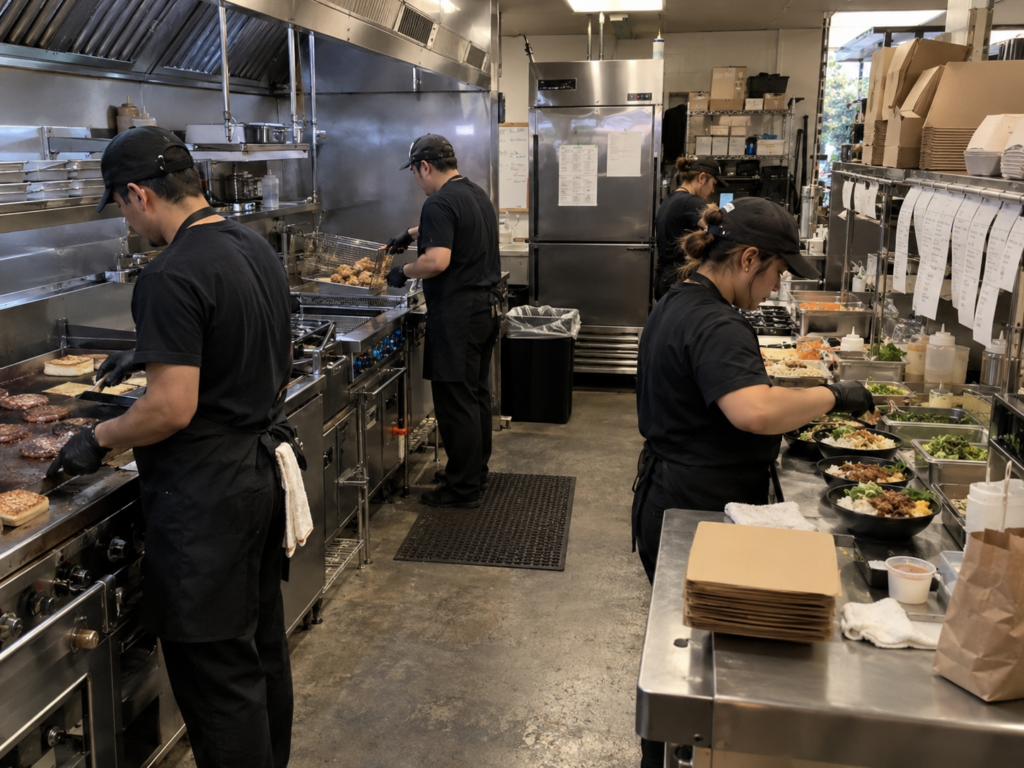
Assume a delivery kitchen launches three menus from one room: burgers, breaded chicken and rice bowls. Its busiest hour is expected to produce 20 burger orders, 18 chicken orders and 10 rice bowls.
On paper, the menus appear compatible. They use some of the same vegetables, sauces, refrigeration and preparation space. The problems emerge when the orders arrive together.
The burger station needs griddle space for patties and possibly onions or buns. Chicken and fries compete for fryer time, while breading creates crumbs that affect oil management and cleaning. Rice bowls introduce another production route involving rice preparation, hot ingredients and portion assembly.
One fryer may be adequate when chicken orders are occasional. During the illustrated peak, that same fryer may force staff to choose between the main product and its side dish. A larger single vat could increase usable cooking space, while two independently controlled tanks could make simultaneous production and cleaning easier. The correct decision depends on normal basket loads, recovery and how the oil will be managed.
The refrigeration decision is different. One large cabinet may hold enough total inventory, yet cooks may repeatedly leave their stations to collect ingredients. Bulk storage combined with smaller working refrigeration near the griddle and assembly area could support the same menu with less movement.
Packing creates the final constraint. Forty-eight orders in an hour need somewhere to be checked, closed, labelled and organized for collection. If this work takes over the preparation table, the kitchen loses production space precisely when demand is highest.
This example explains why a ghost kitchen should not be treated as a smaller conventional restaurant. For the broader planning process, start with Tarzan’s guide to building a restaurant kitchen equipment list. The delivery-only format then needs its own decisions about shared capacity, packaging and dispatch.
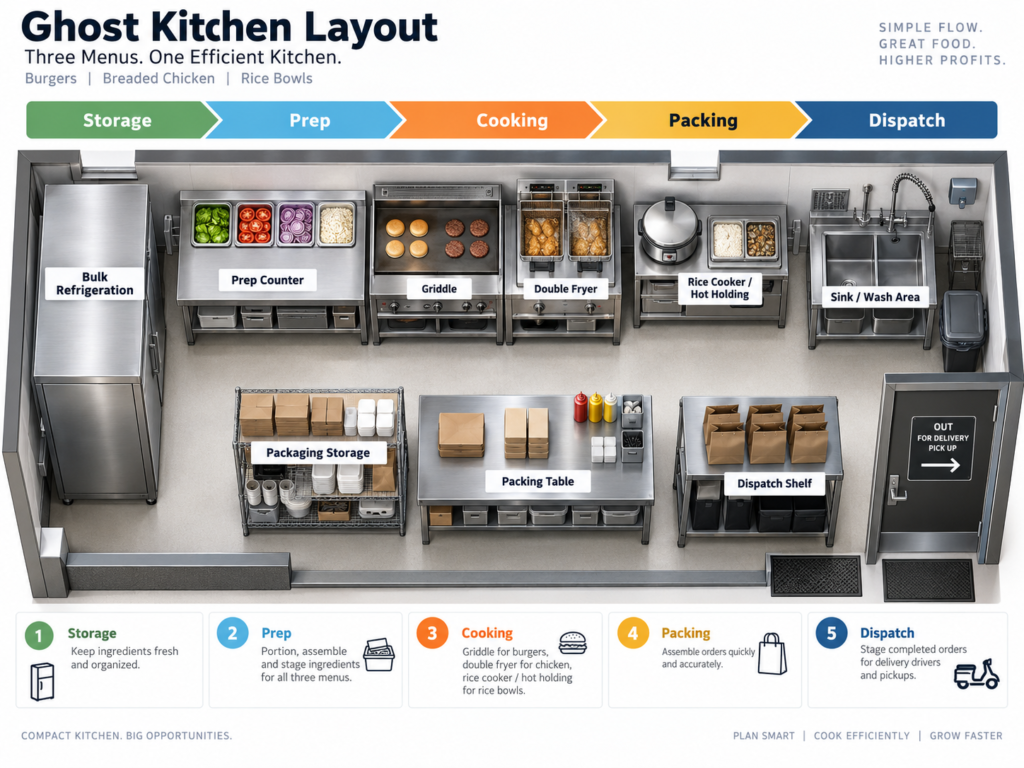
Dedicated and shared equipment
Equipment can be shared when the production process is genuinely compatible.
Refrigerated storage, stainless-steel preparation surfaces and some washing facilities may serve several menus if their usable capacity, cleaning procedures and food-separation controls support the arrangement. A griddle may handle products from two brands when they use compatible cooking conditions and their peak loads do not occupy the entire surface at once.
Cooking equipment becomes harder to share when demand overlaps. Two menu items may use the same appliance but require it during the same five minutes. In that situation, theoretical versatility does not create additional capacity.
Dedicated equipment is also easier to justify when products require different operating temperatures, cleaning schedules or oil conditions. A breaded-chicken menu, for instance, can place a different sediment load on a fryer than frozen fries. Buyers should examine the actual frypot, filtration arrangement and recovery behaviour rather than assuming any two machines with similar oil capacity will perform alike. Tarzan’s commercial deep fryer buying guide covers those model-level questions.
The decision does not automatically lead to more machines. A ghost kitchen with limited fried-food demand may manage with one correctly sized fryer. Another operation may need two tanks even though both kitchens have the same menu. The difference is simultaneous peak demand.
The same test applies before comparing other commercial cooking equipment: identify which products use the machine, how long each cycle occupies it and whether those demands collide during the busiest service period.
Equipment that can wait
Opening-day budgets are often weakened by equipment purchased for sales that have not happened yet.
A specialized appliance for one low-volume menu item may occupy valuable line space while the main products remain short of refrigeration or preparation capacity. An automated processor may reduce labour in theory, but the saving is small if the task currently takes only a few minutes per shift.
Expansion equipment should have a trigger. That trigger could be a recurring production queue, documented overtime, rejected orders, a menu item reaching a defined sales level or the decision to add another location. Without such evidence, buying for an imagined future can make the current kitchen more crowded.
There is one exception worth treating carefully: a single point of failure. If losing one machine would stop most sales and local repair support is slow, the operator may need spare parts, a backup method or a second unit. The right answer depends on equipment criticality, service access and the cost of downtime, not on a general rule that every appliance requires a spare.
Refrigeration and working stock
A ghost kitchen needs enough cold storage for purchasing volume and enough working stock for service. Those are related requirements, but they are not identical.
Bulk refrigeration may be positioned away from the hot line. Ingredients needed repeatedly during service should be accessible without staff crossing cooking or dispatch routes. A refrigerated counter can sometimes combine cold storage with a usable preparation surface, although buyers still need to check its internal layout, ambient-temperature limits and ventilation clearance.
Delivery frequency changes the calculation. A kitchen receiving ingredients daily may require less reserve capacity than an operation receiving two larger deliveries each week. Menu expansion also consumes refrigeration before it consumes visible cooking space because every new brand adds ingredients, containers and partially prepared products.
When comparing commercial refrigeration equipment, record maximum stock by product, delivery intervals and the quantity that must remain beside each workstation. Cabinet litres alone do not show whether the doors, shelves and working height suit the operation.
Packing and dispatch
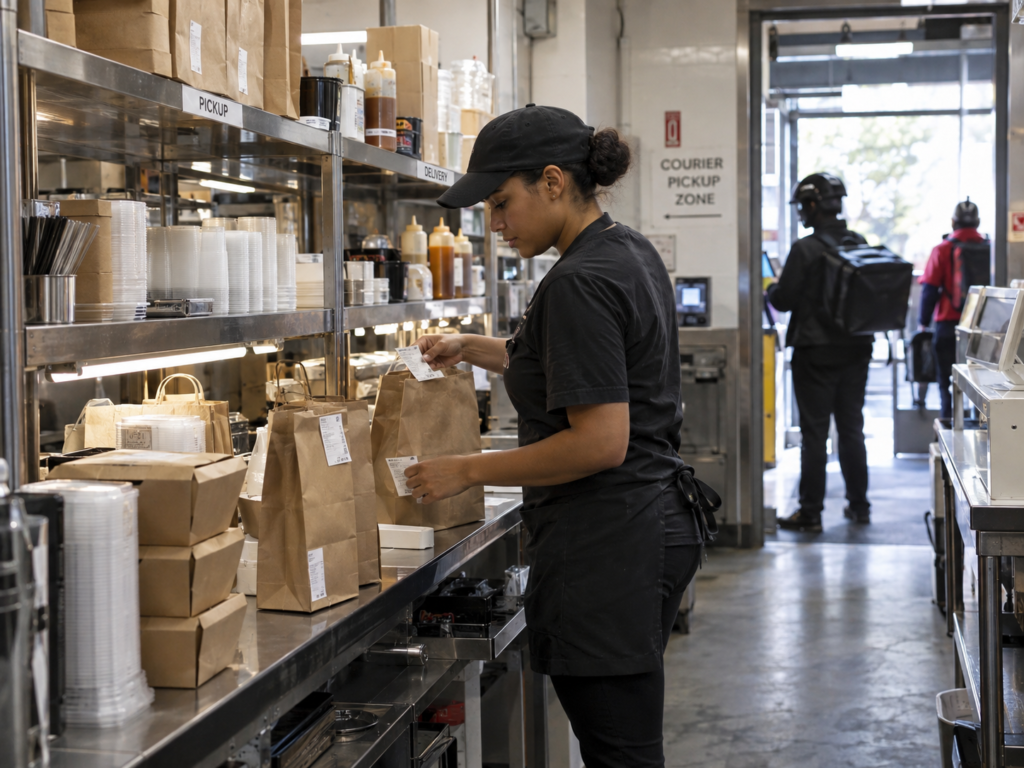
In a ghost kitchen, production continues after cooking.
Hot food, cold drinks, sauces and side dishes must reach the correct container and then the correct customer. Packaging materials need dry storage near the packing area, but not so close that cartons or bags interfere with heat, grease or cleaning.
The dispatch area also needs enough landing space for several completed orders. A narrow shelf may work during quiet periods and fail when multiple drivers arrive together. If collection happens beside the cooking line, drivers and staff may block one another even though the kitchen has sufficient cooking capacity.
Multiple virtual brands add another layer. Similar menus can share ingredients and equipment effectively. A new brand that introduces a different cooking process, more packaging formats and another peak-hour queue may cost more operationally than its short product list suggests.
The practical test is simple: follow one busy order from the cooking appliance to the courier. Every handoff needs a defined surface, storage position or route. Empty floor area on a drawing does not automatically become usable dispatch space.
Utilities, ventilation and local approval
Compact kitchens leave little room for configuration mistakes.
Before selecting models, confirm the available voltage, frequency, phase and electrical load. Gas equipment requires the correct gas type, pressure and connection. Water, drainage, ventilation, fire-protection provisions and service clearances must be checked where they apply.
Equipment dimensions should also be tested against the delivery route, not only the final floor position. A machine that fits under the hood may still be unable to pass through the building entrance, corridor or lift.
Foodservice requirements vary by jurisdiction. In the United States, the FDA Food Code is a model used by regulatory authorities when developing food-safety rules; project approval still depends on the requirements adopted locally. Buyers in other markets should confirm the corresponding rules with the relevant authority, kitchen designer and installer before ordering.
Operating cost deserves a model-level comparison. ENERGY STAR’s commercial food-service equipment resources include specifications and calculation tools for several eligible equipment categories. Buyers should use local energy prices and expected operating hours rather than accepting an unsupported claim that one configuration will always cost less to run.
From equipment plan to RFQ
A useful quotation request describes the kitchen before it asks for prices.
For each major machine, provide the food process, expected peak load, available space and utility configuration. Add the model or preferred format, quantity, destination market and any documentation, branding or packaging requirements. This gives the supplier enough information to question an undersized, oversized or incompatible selection.
Importers planning several outlets should also decide which specifications must remain standard across locations and which may change by site. Voltage, gas supply, line width and ventilation can vary even when the menu is identical. Standardizing a model without checking those differences can simply repeat the same mistake at scale.
Tarzan’s factory and production process page explains how product configuration, inspection and export packing are handled. When the operating plan and quantities are ready, buyers can use the commercial kitchen equipment RFQ to request a model review and quotation.
A ghost kitchen has enough equipment when its peak orders can move from storage to dispatch without competing for the same machine, surface or utility connection. Anything beyond that needs to earn its space.