
This commercial deep fryer buying guide helps restaurant owners, distributors, and project buyers choose a fryer according to the menu, peak production demand, tank design, energy supply, filtration method, and installation conditions. Tank capacity alone does not show how the equipment will perform when several baskets are loaded during a busy service period.
A fryer that handles frozen French fries effectively may not be suitable for fresh breaded chicken. A compact countertop model may work well in a café but fall behind in a fast-food restaurant where baskets are loaded continuously. The correct configuration depends on the food, production pattern, available utilities, and daily cleaning requirements.
The following sections compare frypot designs, countertop and floor-standing models, gas and electric fryers, tank configurations, filtration systems, controls, installation requirements, and long-term operating costs.
Commercial Deep Fryer Buying Guide: Start With the Menu
The menu is the most useful starting point because it determines what enters the oil and how quickly the oil becomes contaminated. Frozen fries usually release relatively little sediment, while hand-breaded chicken can leave a large amount of loose coating in the frypot. Wet-battered products behave differently again because they may sink before the coating sets and the food rises.
Before comparing commercial deep fryers, identify whether the food is fresh, chilled, frozen, breaded, battered, or pre-cooked. Consider whether different products can share the same oil and whether they require the same frying temperature. Fish, chicken, fries, and sweet dough products may need separate tanks to prevent flavor transfer and simplify production.
Allergen separation also requires more than separate oil. Baskets, utensils, filters, containers, preparation surfaces, and staff procedures must be considered together. A twin-tank fryer can support separation, but it does not create a complete allergen-control system by itself.
A Practical Fryer Selection Path
A useful purchasing sequence is:
Menu → food condition → sediment level → peak-hour demand → frypot design → tank configuration → gas or electricity → filtration → installation conditions
Following this sequence prevents buyers from choosing a fryer only because it has a large tank or a low purchase price.
Judge Demand During the Busiest Hour
Daily sales can hide the real production requirement. A restaurant may sell fried food steadily throughout the day but receive most orders during two short service periods. The fryer must handle those peaks without creating long waiting times or inconsistent batches.
The buyer should estimate the largest normal basket load, the number of baskets required during the busiest hour, the interval between basket drops, and how long the fryer operates continuously. It is also important to consider whether several products are cooked at the same time.
Frozen food and large basket loads reduce the oil temperature after each drop. If the heating system cannot restore the operating temperature quickly enough, cooking becomes slower and the finished product may absorb more oil. This is why a larger tank does not automatically mean greater production capacity.
For occasional frying, a countertop deep fryer may be sufficient. Kitchens that depend heavily on fried food generally need a floor-standing commercial fryer with greater heating capacity and more space for repeated basket loads.
Compare the Main Frypot Designs
Commercial fryers are commonly divided into tube-type, open-pot, and flat-bottom designs. The difference is not cosmetic. Each design handles heat, sediment, food movement, and cleaning in a different way.
| Frypot design | Commonly used for | Main advantage | Main consideration |
|---|---|---|---|
| Tube-type | Breaded chicken, breaded fish, high-sediment foods | Crumbs can settle below the main cooking area | Internal tubes require more detailed cleaning |
| Open-pot | Fries, frozen snacks, low-sediment foods | Open interior is easier to access | Sediment capacity differs between models |
| Flat-bottom | Tempura, battered fish, doughnuts, funnel cakes | Broad bottom suits products that sink before rising | Oil must be filtered and cleaned carefully |
Tube-Type Fryers
A tube-type fryer has heat-transfer tubes running through the frypot. The food cooks above the tubes, while loose breading and crumbs can settle into a lower area.
This design is commonly used for fresh breaded chicken, breaded fish, and other products that release a large amount of sediment. Keeping crumbs away from the main cooking area can reduce the amount of debris circulating around the food.
The trade-off is cleaning. Oil, breading, and sediment can collect around and beneath the tubes. Buyers should check whether staff can reach these areas with the supplied cleaning tools and whether the drain valve can handle the expected sediment load.
A tube fryer is not automatically the best choice for every high-volume kitchen. It is most useful when the menu produces enough crumbs to justify the more complex internal structure.
Open-Pot Fryers
An open-pot fryer does not have gas tubes crossing the centre of the frypot. The more open interior generally gives staff better access to the sides, bottom, drain area, and temperature probes.
Open-pot fryers are commonly used for frozen fries, potato products, and other low-sediment foods. They can also suit kitchens where fast, straightforward cleaning is a priority.
However, the term “open pot” does not guarantee the same performance across every model. Buyers still need to compare heating power, oil capacity, sediment space, drain design, controls, and recovery during repeated basket loads.
Flat-Bottom Fryers
A flat-bottom fryer provides an unobstructed lower surface. This makes it suitable for foods that initially sink into the oil and rise as they cook.
Typical applications include tempura, wet-battered fish, doughnuts, churros, funnel cakes, and battered vegetables. These products need room to move without becoming trapped around internal tubes.
Because some flat-bottom designs have a limited cold zone, sediment may remain closer to the heated area. The kitchen therefore needs a consistent filtration and cleaning routine, especially when the batter releases fine particles.
Choose Between a Countertop and Floor-Standing Fryer
The choice between countertop and floor-standing equipment should be based on production pattern rather than kitchen size alone.
| Operating condition | Countertop fryer | Floor-standing fryer |
|---|---|---|
| Fried food is a small part of the menu | Usually suitable | May be unnecessary |
| Space is extremely limited | Strong advantage | Requires dedicated floor area |
| Frying continues through long service periods | May be undersized | Usually more appropriate |
| Built-in filtration is required | Limited availability | More widely available |
| Several tanks are needed | Less practical | Better suited |
| Future production growth is expected | Limited flexibility | Greater expansion potential |
When a Countertop Fryer Makes Sense
Countertop fryers can work well in cafés, snack bars, food trucks, bars, convenience stores, and restaurants where frying is a secondary cooking process. They occupy less space and may be easier to install when the correct electrical or gas connection is already available.
Compact dimensions do not necessarily mean simple electrical requirements. A commercial countertop fryer may still need a dedicated circuit, higher voltage, or hard-wired installation. The supporting counter must also be strong enough to carry the fryer safely and provide sufficient clearance around hot oil.
The main limitation is usually continuous production. A countertop fryer may handle one normal batch without difficulty but lose temperature when frozen baskets are loaded repeatedly.
When a Floor-Standing Fryer Is More Practical
A floor-standing fryer is generally better suited to fried chicken shops, fast-food restaurants, hotel kitchens, central kitchens, and operations where fried food represents a large part of the menu.
Floor models can provide more basket space, higher heating input, larger sediment areas, integrated filtration, and multiple independent vats. They can also be arranged in a fryer battery when several products must be produced at the same time.
The buyer should still avoid purchasing excessive capacity. A large fryer that remains half-used for most of the day may consume more oil and occupy more space than the operation actually needs.
Select the Right Tank Configuration
Tank configuration affects menu flexibility, cleaning schedules, flavor separation, and how much equipment must remain running during quieter periods.
Full-Pot Fryers
A full-pot fryer concentrates the available cooking area in one vat. It is suitable when one product dominates the menu, most foods use the same oil, and the operation needs the largest possible basket space.
A restaurant producing a high volume of fries may prefer one large vat rather than dividing the capacity between two smaller sections.
The disadvantage is that the whole frying station may become unavailable during cleaning or maintenance. A full pot also offers less flexibility when products require different temperatures.
Split-Pot and Twin-Tank Fryers
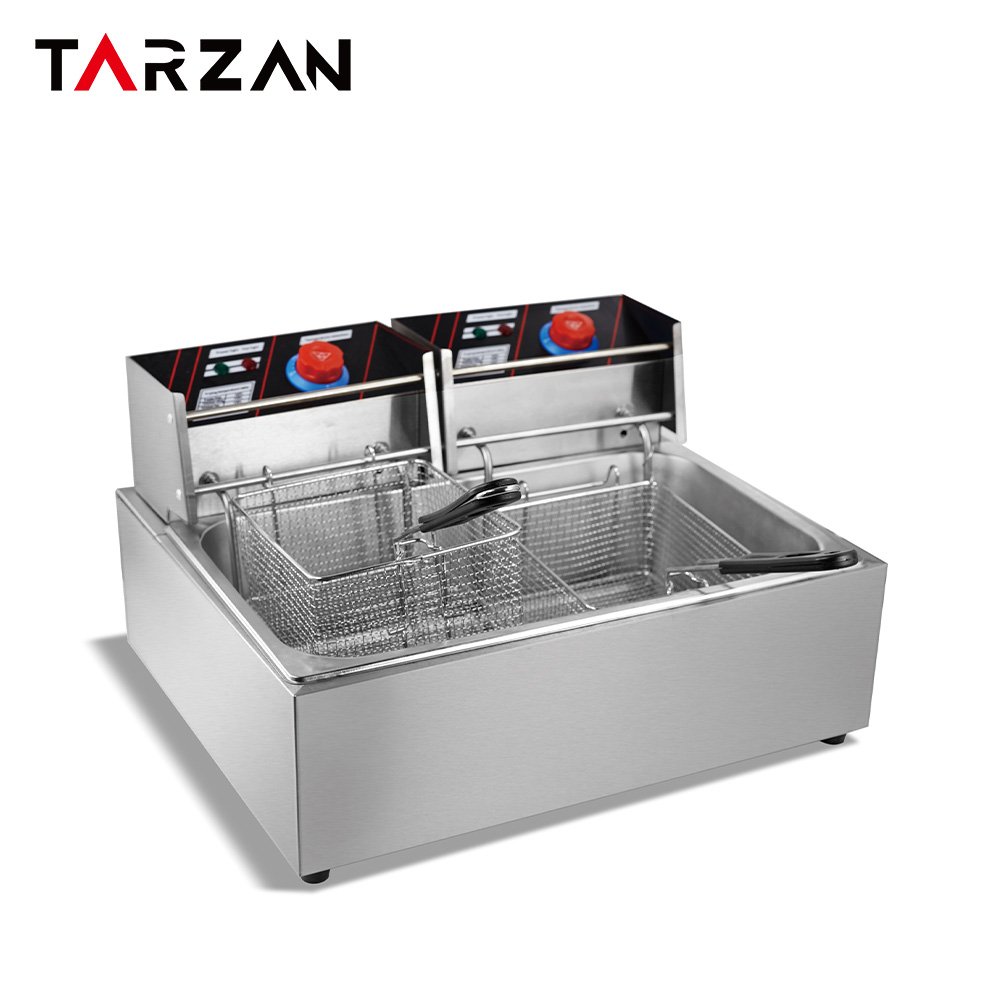
A [Anchor text: twin tank deep fryer] provides two separate frypots, while a split-pot fryer divides the cooking area into smaller independently controlled sections.
These configurations are useful when fish and fries should not share oil, when two foods require different temperatures, or when one side must remain available while the other is cleaned. They also allow an operator to run only one tank during quieter periods instead of heating the full oil capacity.
Before ordering, confirm whether the tanks have independent temperature controls, timers, heating systems, drain valves, high-limit protection, and filtration connections. Two tanks inside one cabinet do not always mean that every system operates separately.
Compare Gas and Electric Fryers at the Installation Site
Gas and electric fryers can both perform reliably in commercial kitchens. The correct choice depends on local utilities, installation cost, operating hours, service support, and the configuration of the specific model.
Commercial Electric Fryers
Electric fryers commonly use heating elements positioned directly in or around the oil. This can provide responsive temperature control and makes electric models common in countertop applications.
An electric fryer may be practical where gas is unavailable, where the building already has sufficient electrical capacity, or where the kitchen prefers equipment without gas combustion.
Before placing the order, the buyer must confirm the voltage, phase, frequency, total connected load, current requirement, plug type, and circuit protection. These details are especially important for imported equipment because electrical standards differ between countries.
A fryer configured for the wrong voltage or phase may not work at the destination site, even if its physical size and oil capacity appear suitable.
Commercial Gas Fryers
Gas fryers use burners to transfer heat through tubes, the frypot wall, or another heat-exchange structure. They are widely used in floor-standing and high-volume configurations.
A gas fryer may be suitable where the building already has a commercial gas supply and local gas prices are competitive. The buyer must confirm whether the site uses natural gas or LPG, as well as the required inlet pressure, connection size, regulator, flue arrangement, and combustion-air requirements.
A natural-gas fryer should not be connected to LPG without the correct conversion components and technical approval.
Do Not Rely on General Claims
Statements such as “gas is always faster” or “electric is always cheaper” are too broad to support a purchasing decision.
The more useful comparison is the actual installation cost, local energy tariff, expected operating hours, recovery under load, idle periods, ventilation requirements, technician availability, and spare-parts access.
For distributors, the destination market matters as much as the equipment type. Voltage, frequency, gas pressure, plug standard, control language, and certification requirements should be confirmed before production.
Treat Filtration as Part of the Frying System
Oil filtration affects food quality, cleaning time, labour, and operating cost. It should not be treated as a minor accessory added after the fryer has already been selected.
Crumbs and sediment continue to cook while they remain in the oil. Over time, they can darken the oil and affect the flavor and appearance of the food.
Commercial kitchens may use manual filter cones, portable filter machines, filter drawers, built-in filtration, shared filtration for several vats, or automatic systems. The correct choice depends on how much food is produced and how much sediment the menu creates.
A small café may be comfortable with an external filter machine. A fried chicken operation with several vats may benefit more from built-in filtration that reduces the need to move hot oil manually.
What to Check in a Filtration System
Rather than comparing only whether a fryer “has filtration,” examine how the system works during daily operation.
The filter pan should be easy to remove and clean. Staff should be able to access the screen, pump, oil-return line, and drain without dismantling large sections of the fryer. The buyer should also confirm whether each vat can be filtered independently and whether another tank can remain in operation during the process.
Filter paper, powder, screens, seals, and pump components may be regular consumables or service parts. Their availability should be considered before the equipment is installed.
Avoid Fixed Oil-Replacement Rules
There is no single oil-change schedule that applies to every restaurant.
Oil condition changes according to the food, amount of breading, operating temperature, moisture, seasoning, production volume, filtration frequency, and cleaning practice. A fryer used mainly for frozen fries may not contaminate oil at the same rate as one used for heavily breaded chicken.
The kitchen should establish a consistent oil-management procedure based on food quality, oil condition, filtration results, and the instructions provided by the fryer and oil suppliers.
Check Cleaning Access Before Ordering
A fryer may look easy to maintain in a product photograph but become difficult to clean once installed between other appliances.
The buyer should consider whether staff can reach the frypot corners, heating tubes, elements, probes, sediment area, drain valve, filter pan, and surfaces behind the fryer. If these areas are difficult to access, routine cleaning is more likely to be delayed or performed inconsistently.
Tube fryers require appropriate brushes for cleaning around the internal tubes. Electric fryers with lift-up elements may provide better access, although the lifting mechanism and electrical connections also require maintenance.
The drain valve deserves particular attention. It should be positioned so oil can be removed safely and large enough to reduce blockage from sediment.
Maintenance Warning Signs
Oil leaks, slower heating, difficulty maintaining temperature, uneven results between baskets, blocked drain valves, unusual burner flames, repeated high-limit shutdowns, and noisy filtration pumps should not be treated as normal operating behaviour.
The fryer should be inspected according to the supplier’s maintenance instructions. Gas valves, burners, heating elements, thermostats, temperature probes, controls, and filtration components all affect safe and reliable operation.
The lowest-priced fryer may become expensive if replacement parts are difficult to obtain or the kitchen must stop production while waiting for repairs.
Choose Controls That Solve a Real Problem
Additional controls are useful when they improve a specific part of the workflow. They should not be selected simply because a longer feature list looks more advanced.
Programmable Controls
Programmable controls can store cooking times and temperatures for different products. They are useful in kitchens with several shifts, high employee turnover, multiple fried products, or a need for consistent results across several locations.
Buyers should confirm how many programs can be stored, whether settings can be locked, and whether the control language is suitable for the operating team.
Automatic Basket Lifts
Basket lifts raise the basket when the programmed cooking cycle ends. They can reduce overcooking when staff are handling several tasks at once.
The mechanism adds moving parts, so the buyer should ask whether the fryer can continue operating manually if the lift requires service.
Automatic Oil Top-Off
An automatic top-off system replaces oil lost through normal food absorption and removal. This helps maintain a consistent oil level during busy service.
It does not replace filtration or oil-quality checks. The oil reservoir, refill method, cleaning access, and compatible oil container should be confirmed before purchase.
Basic Controls May Be Enough
A small restaurant may benefit more from a reliable thermostat and simple timer than from a complex digital control system.
Controls should be easy to read, clean, and operate while wearing gloves. Replacement parts and technical support may be more important than the number of available programs.
Confirm Ventilation and Installation Conditions
A fryer must be selected together with the kitchen’s ventilation, fire-protection, and utility systems.
Gas fryers produce combustion gases, while both gas and electric fryers can release grease-laden vapour. Hood requirements, exhaust capacity, fire suppression, wall clearances, and equipment spacing depend on local regulations and the installation site.
A ventless fryer should not automatically be treated as exempt from local approval. Acceptance depends on the exact equipment, food process, installation method, and local authority.
Service access is also important. A fryer installed tightly between other appliances may be difficult to pull forward when technicians need to reach the burners, elements, control panel, gas valve, electrical connection, filtration pump, or drain system.
Utility connections should be positioned so the equipment can be disconnected safely for service.
Compare the Total Operating Cost
Purchase price is only one part of the cost of owning a commercial fryer.
Operating cost can include gas or electricity, frying oil, filtration consumables, cleaning chemicals, employee cleaning time, replacement baskets, drain-valve parts, controls, pumps, technician visits, and production lost during downtime.
A built-in filtration system may increase the initial price but reduce manual oil handling. A simple mechanical controller may be easier to repair in a market where digital control boards are difficult to source.
The correct balance depends on production volume, labour cost, technician access, and the operating environment.
Confirm Spare-Parts Support
Before placing a bulk or project order, ask which components are considered routine service parts.
Baskets, thermostats, heating elements, temperature probes, high-limit controls, ignition components, gas valves, drain valves, filter screens, pumps, and control boards may all require replacement during the equipment’s working life.
Distributors should also request operating manuals, wiring diagrams, gas diagrams, troubleshooting information, parts lists, and packaging details.
Prepare the Right Information Before Requesting a Quotation
A useful quotation request should explain how the fryer will be used. Sending only a message asking for “a commercial fryer price” gives the supplier too little information to recommend an appropriate configuration.
| Information | What the buyer should provide |
|---|---|
| Menu | Fries, chicken, fish, doughnuts, tempura, snacks, or other foods |
| Food condition | Fresh, chilled, frozen, breaded, battered, or pre-cooked |
| Production demand | Largest normal batch and busiest service period |
| Operating pattern | Continuous production or occasional basket loads |
| Fryer format | Countertop or floor-standing |
| Tank configuration | Full pot, split pot, twin tank, or several fryers |
| Energy source | Electricity, natural gas, or LPG |
| Utilities | Voltage, phase, frequency, gas type, and available pressure |
| Installation space | Available width, depth, height, and service clearance |
| Ventilation | Existing hood, planned hood, or ventless application |
| Filtration | Manual, portable, built-in, or automatic |
| Commercial requirements | Quantity, branding, packaging, spare parts, and destination |
When contacting Tarzan Kitchen, provide the menu, expected peak demand, preferred fryer format, installation space, and destination-country utility conditions. This allows the supplier to recommend a suitable configuration before the buyer compares individual models.
Buyers can review commercial cooking equipment or submit project details through request a commercial fryer quotation.
Frequently Asked Questions About Commercial Deep Fryers
What type of fryer is suitable for breaded chicken?
A tube-type fryer is commonly used for heavily breaded chicken because loose crumbs can settle below the main cooking area. The buyer should also compare sediment capacity, filtration, drain design, cleaning access, and recovery during repeated basket loads.
Is a gas or electric fryer better for a restaurant?
Neither option is automatically better. Electric fryers may suit sites with sufficient electrical capacity, while gas fryers may be more practical where commercial gas is already available. The correct decision depends on local utility costs, installation conditions, operating hours, service support, and the specifications of the actual fryer.
When should a restaurant use a twin-tank fryer?
A twin-tank fryer is useful when foods require separate oils, different temperatures, flavor separation, or independent cleaning schedules. It can also allow the kitchen to operate only one tank during quiet periods.
Can a countertop fryer handle fast-food production?
A countertop fryer may handle a limited menu or moderate demand, but it can become undersized during continuous service. Peak basket load, recovery, available power, and the length of the busiest service period should be checked before choosing a compact model.
How often should fryer oil be filtered?
The frequency depends on the food, sediment level, breading, moisture, production volume, oil condition, and filtration system. A heavily breaded menu normally requires more frequent filtration than a low-sediment frozen-food menu.
Does a ventless fryer eliminate the need for a hood?
Not in every location. Approval depends on the fryer, cooking process, local building and fire requirements, and the authority responsible for the site. Ventilation approval should be confirmed before the equipment is ordered.
Choose the Fryer Around the Real Operation
A commercial fryer should not be selected only by oil capacity, heating input, or purchase price. The more important question is whether the fryer matches the menu, peak demand, sediment level, available utilities, and daily cleaning routine.
Start with the food, then determine the required frypot design, tank arrangement, energy source, filtration method, and installation conditions. After that, compare controls, spare-parts support, and total operating cost.
A clear operating brief helps the supplier recommend the correct fryer and reduces the risk of purchasing equipment that is too small, unnecessarily large, difficult to clean, or incompatible with the installation site.